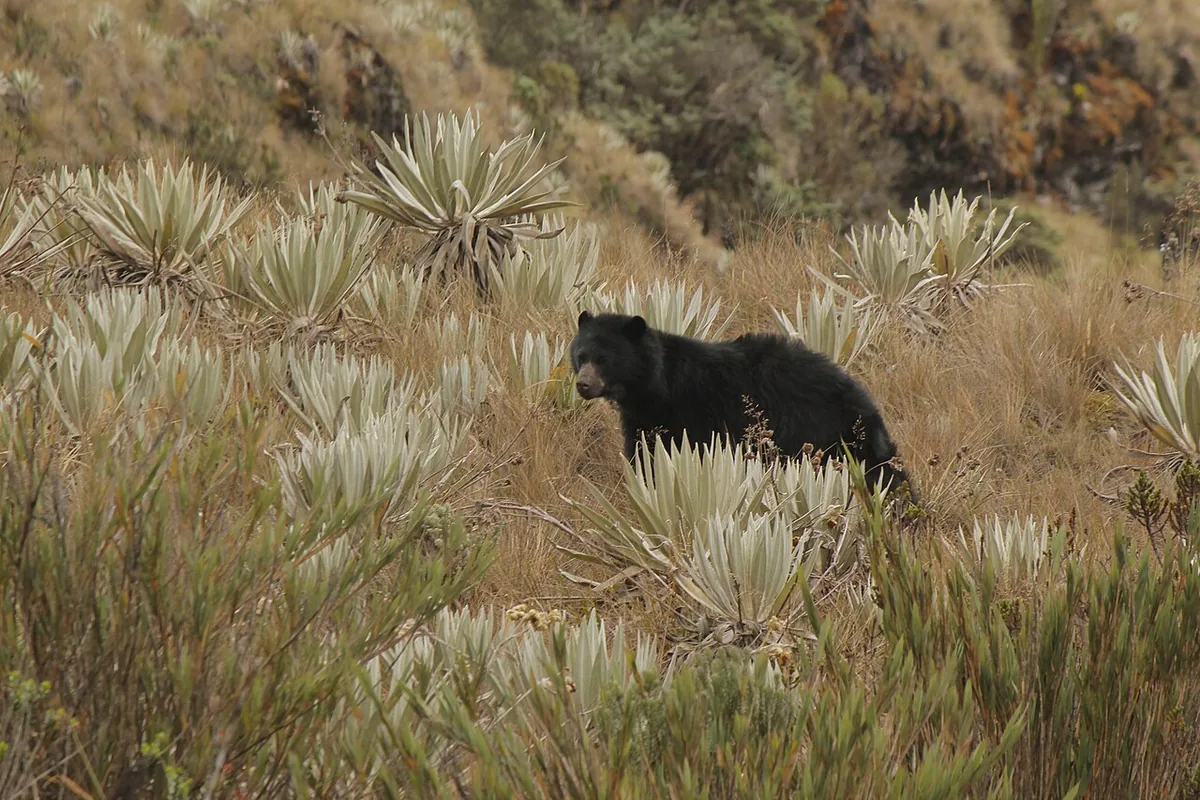
A young Andean bear climbs trees in Farallones de Cali Park
Read in English
Machine translation
 Machine translation
Some park rangers filmed a young Andean bear climbing trees in a nature park in Colombia. National Parks published the video on Thursday 15 October.
A young Andean bear appeared in a video climbing trees in Farallones de Cali National Natural Park, in Colombia. Colombia's National Natural Parks, the institution that looks after the country's parks, shared the video on Thursday 15 October 2026. The news reports do not say when it was filmed.
It was filmed by some park rangers, people who look after a nature park, while they were out on a patrol to watch over and protect the forest. In the footage, the bear can be seen several metres above the ground, moving among the branches. National Parks said that this record is ‘an indicator of the good state of conservation’ of the park.
Farallones de Cali Park is in the department of Valle del Cauca, between the Andes mountains and the Pacific Ocean. In February 2026, the camera traps in the same park had already recorded another bear passing by. A camera trap is a hidden camera that switches on when an animal walks past.
The Andean bear, which is also called the spectacled bear, lives only in the tropical Andes. In Colombia it has been seen in the páramos of the three mountain ranges and it lives in 22 of the country's 59 National Parks. A páramo is a high place in the mountains, with a cold climate.
According to the organisation WWF, this animal is called an ‘umbrella species’. Looking after it also protects the páramos, the cloud forests and many other species that live there. In addition, because of what it eats and the long journeys it makes, it helps to spread seeds and to make forests last.
Its biggest threat is losing its home, because farmland is spreading. Even so, National Parks sees this video as a good sign for the park.
Gus and Julie, on the way to school

The bear spreads seeds wherever it wanders and through what it eats. It's a seed delivery bear, like me, but with claws!

Bears look after the forest without knowing it. Which animal do you think helps nature the most, and why?
Questions
Tap the answer you think is right.
Who filmed the video of the Andean bear?
When did National Parks share the video?
What is a camera trap?
Why is the Andean bear called an ‘umbrella species’?
Park rangers walk through the forest to look after it. Would you like to do that job when you grow up? Write two reasons.
Is there an animal of the mountains or forests, in Sweden or in your family's country, that needs protecting? Tell us about it or imagine how it could be helped.
What has happened since then?
 What has happened since then?
How many Andean bears have been recorded in Farallones de Cali Park since then?
Find out in the library, by asking someone or by searching with an adult. This story is from October 17, 2026: what have you discovered since that date?
 Print worksheet