A Chilean astronomer finds 52 distant galaxies with lots of gas to make stars
Read in English
Machine translation
 Machine translation
Chilean astronomer Victoria Catán and her team found cold gas in 52 very distant galaxies. That gas is the fuel that stars are born from.
On Wednesday 4 November 2026, a discovery from space was announced in Chile. Chilean astronomer Victoria Catán, who is studying for her doctorate at the Pontifical Catholic University of Chile, led an international team of scientists. Together they found cold gas in 52 very distant galaxies that until then had gone unnoticed.
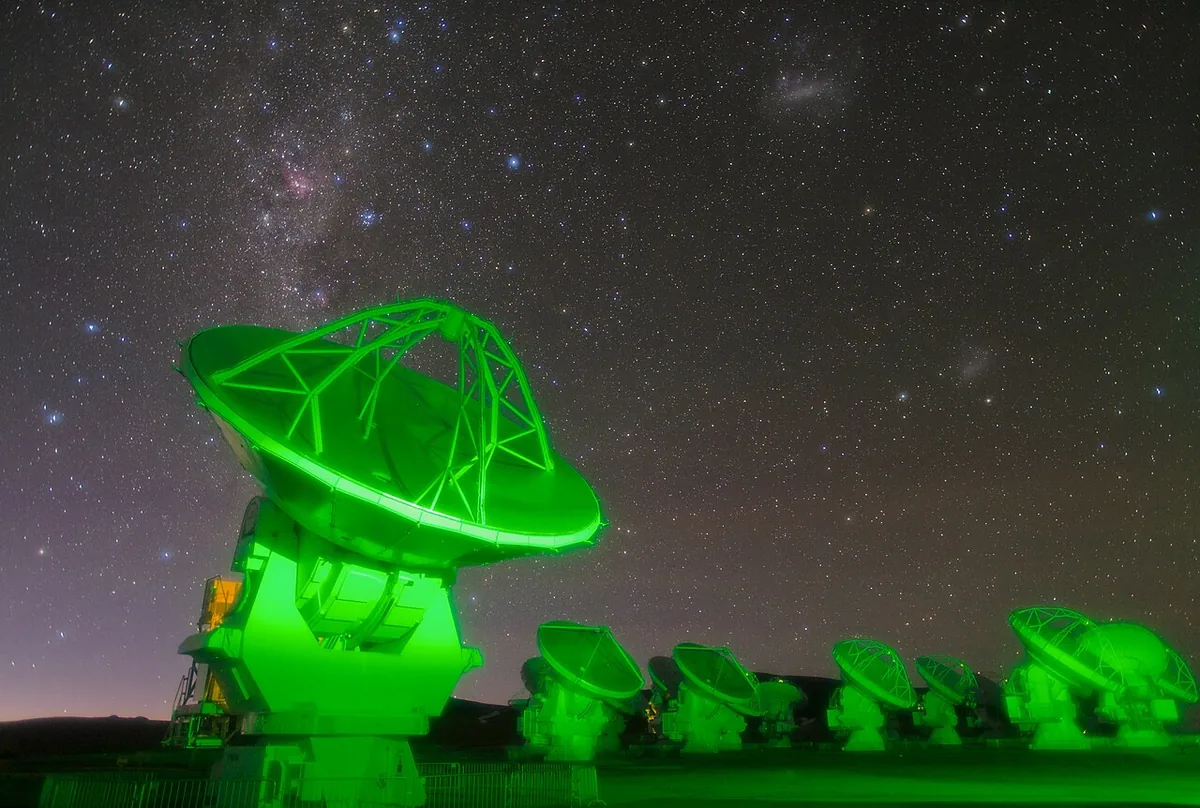
A galaxy is a huge group of stars, gas and dust. Cold gas is very important, because it is the fuel that new stars are born from. To find it, the team used ALMA, a radio telescope in the Atacama Desert, in Chile. A radio telescope picks up the radio waves that arrive from space, and our eyes cannot see them.
Most earlier studies chose galaxies that already shone brightly in the light we can see or in infrared light. This time, however, the scientists looked directly for the signal of the gas. That is how they found faint galaxies, which hardly shine and which traditional telescopes cannot see. The data they used was collected between 2019 and 2023.
These galaxies are so far away that their light takes a very long time to reach us. That is why we see them as they were in the early universe, that is, in the first times of the universe. Some are transition galaxies: they still have gas, but they make stars more slowly than before.
Victoria Catán suggests that, in some of them, activity in the past heated the gas and slowed down the birth of stars. However, she makes it clear that more studies are needed to know whether this happens in all of them. She sums up the discovery with one idea: they found ‘huge reservoirs of fuel’ for making stars.
Gus and Julie, on the way to school

Victoria looked for the gas instead of the light, and that is how she found 52 galaxies that hardly shine. Looking where nobody looks is my favourite trick!

We see those galaxies as they were a very long time ago. If you could see a scene from your past, which one would you choose?
Questions
Tap the answer you think is right.
How many distant galaxies with cold gas did the team find?
What is cold gas for in a galaxy?
What did the scientists do differently from most earlier studies?
What are the ‘transition galaxies’ that the news story talks about?
The astronomer in this news story studies space with a telescope in a desert. If you had to research something about nature or space, what would you like to discover? Explain why, with two reasons.
In Sweden or in your family's country, have you ever looked at the sky at night? Tell us what you saw or what you would like to see, and what questions you ask yourself about space.
What has happened since then?
 What has happened since then?
Have the scientists confirmed whether the gas in those galaxies slowed down the birth of stars?
Find out in the library, by asking someone or by searching with an adult. This story is from November 4, 2026: what have you discovered since that date?
 Print worksheet