 World
The Lucy probe reaches the region of Jupiter's Trojan asteroids
Read in English
Machine translation
 Machine translation
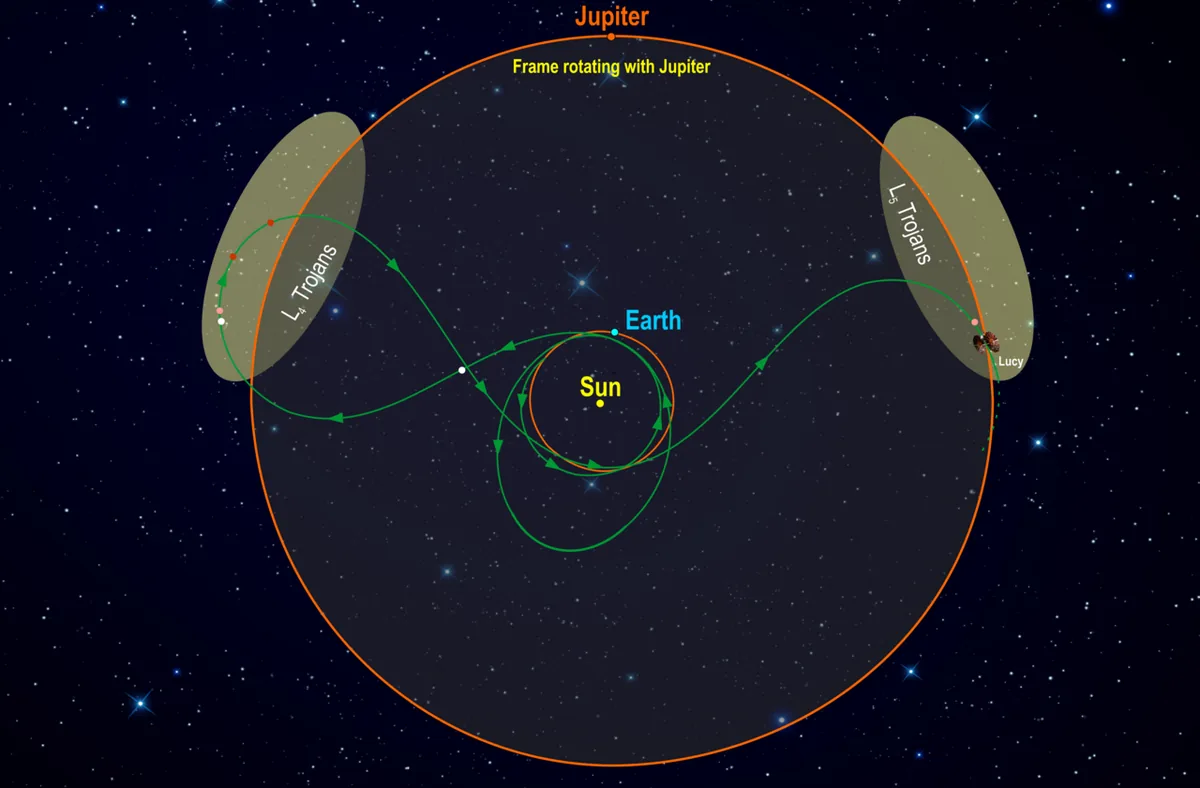
NASA announced that the Lucy probe has reached the region of Jupiter's Trojan asteroids and that it is the first spacecraft to enter that part of the solar system.
NASA, the space agency of the United States, announced on 28 October 2026 that the Lucy probe has reached the region of Jupiter's Trojan asteroids. Lucy took off on 16 October 2021, so its journey has lasted five years. According to NASA, it is the first spacecraft to enter this part of the solar system.
Asteroids are rocks that travel through space. Jupiter's Trojans are very old bodies that share Jupiter's orbit around the Sun. They are divided into two groups: one goes ahead of Jupiter and the other goes behind. Lucy is getting close to the group in front.
To get there, Lucy has travelled more than 3,500 million kilometres. That region is more than five times the distance between the Earth and the Sun. The asteroids are separated by about 10 million kilometres on average, so at first Lucy will see them only as points of light among the stars.
Scientists hope that studying these asteroids will help us understand how the planets formed, about 4,500 million years ago. Other spacecraft have visited Jupiter, but none had visited the Trojans, and Lucy is the only one designed to explore them. According to NASA, its instruments are working as expected and the spacecraft has adapted to it being colder and to less sunlight reaching it.
The close visits will begin in 2027. Lucy is scheduled to pass by Eurybates, the first Trojan on its list, on 11 August 2027 and to study it up close for only a few hours. It is also scheduled to visit the twin asteroids Patroclus and Menoetius in March 2033. In total, the mission has 11 targets: eight Trojans and three bodies from the main asteroid belt.
According to the Wikipedia encyclopaedia, the name Lucy comes from the famous fossil of a human ancestor, which in turn was named after a song by the Beatles. The spacecraft measures more than 16 metres from tip to tip.
Gus and Julie, on the way to school

To draw Lucy's journey I need a really long sheet of paper: 3,500 million kilometres do not fit in my delivery notebook.

If you could send a spacecraft to explore an asteroid, what would you like to find out with it?
Questions
Tap the answer you think is right.
What are Jupiter's Trojan asteroids?
What is special about the Lucy probe, according to NASA?
How will Lucy see the asteroids at first?
How long will Lucy study Eurybates, the first Trojan it will visit, up close?
Scientists use spacecraft like Lucy to understand how the planets formed. What would you like to find out about space? Write two questions that you would ask Lucy.
Scientists have to wait years to see the asteroids up close. Do you think it is worth waiting to learn new things? Have you waited a long time for something important? Tell us about it.
What has happened since then?
 What has happened since then?
What did Lucy discover when it passed the asteroid Eurybates in August 2027?
Find out in the library, by asking someone or by searching with an adult. This story is from October 28, 2026: what have you discovered since that date?
 Print worksheet