 World
The European probe Hera sends the first close-up photo of Didymos and its moon Dimorphos, which NASA hit in 2022
Read in English
Machine translation
 Machine translation
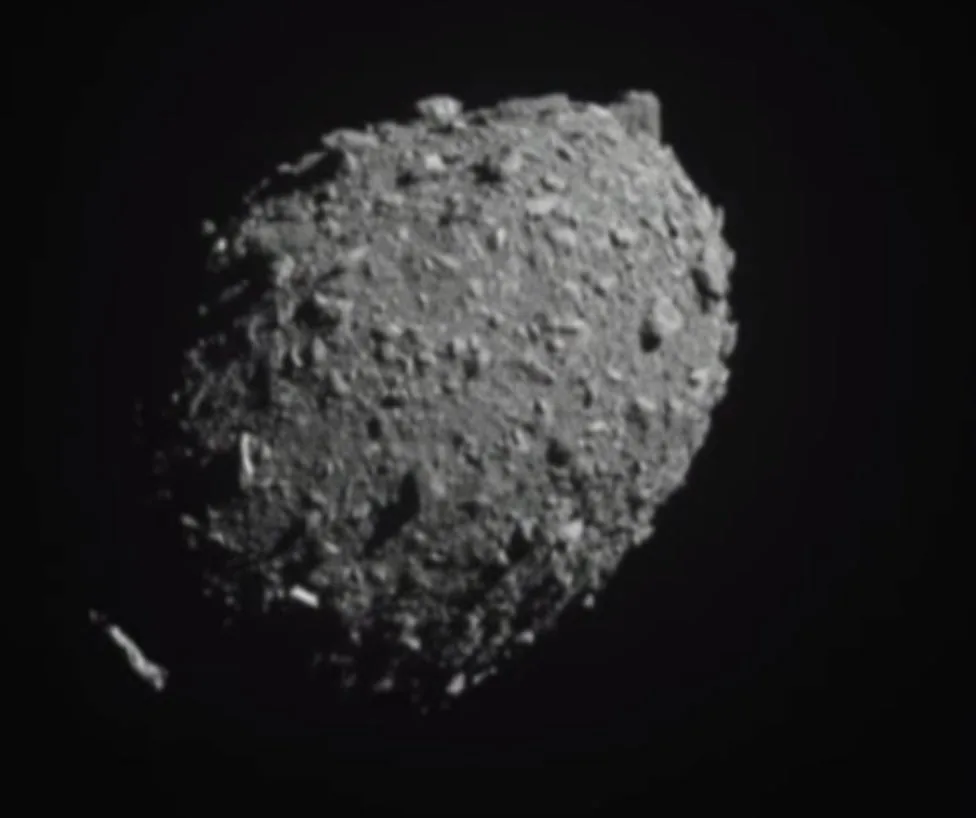
ESA published the first close-up photo of Didymos and its moon Dimorphos, taken by the Hera probe from about 60 kilometres away. In 2022, NASA's DART spacecraft crashed into Dimorphos.
On Thursday 5 November 2026, the European Space Agency (ESA) published a new photo. It is the first close-up photo of the asteroids Didymos and Dimorphos. It was taken by its Hera probe, a spacecraft with no people on board, from a distance of about 60 kilometres.
The photo is in black and white. It clearly shows Didymos, the big asteroid, which is about 780 metres across. Its small moon, Dimorphos, measures about 151 metres and almost hides in the shadow.
In 2022, another spacecraft had already been there. On 26 September of that year, NASA's DART spacecraft crashed on purpose into Dimorphos. It was humanity's first test of pushing an asteroid off course, a ‘planetary defence’ trial, with no danger for anyone.
The crash changed Dimorphos's movement: since then it takes about 33 minutes less to go once round Didymos. It is the first body in the solar system whose orbit has been changed by a human action.
Hera left Earth in October 2024 and has travelled for about two years. Its photo shows the side of Didymos opposite to the one DART's camera saw before the crash. There are big rocks, craters, grooves and a ridge. The scientists think that part of what can be seen could be material that was thrown off Dimorphos after the crash and fell onto Didymos.
Hera also carries two mini-satellites, Milani and Juventas, the size of a shoebox, which it will release later on. The mission wants to know whether Dimorphos is a pile of loose stones or a solid rock, and what the crash crater is like. ESA is expected to show more detailed images of the two asteroids on Wednesday 25 November 2026.
Gus and Julie, on the way to school

Dimorphos goes round Didymos, like Crumb following me around to copy me. And Hera travelled for two years to see them!

If Hera could send you a photo of any corner of Didymos, what would you like to find in it?
Questions
Tap the answer you think is right.
Which NASA spacecraft crashed on purpose into Dimorphos in 2022?
How many fewer minutes does Dimorphos take to go once round Didymos since the crash?
Which side of Didymos is seen in Hera's photo?
What does the mission want to find out about Dimorphos?
Do you think it is a good idea to use a spacecraft to test how to push an asteroid off course? Explain your opinion with two reasons.
Hera and its mini-satellites want to find out what Didymos and Dimorphos are like. What would you like to find out about an asteroid? Write a question and explain why it interests you.
What has happened since then?
 What has happened since then?
What has Hera discovered about Dimorphos? Is it a solid rock or a pile of loose stones?
Find out in the library, by asking someone or by searching with an adult. This story is from November 5, 2026: what have you discovered since that date?
Sources
Educational adaptation of ESA · Nov 5, 2026
- EarthSky · Hera mission gets its 1st closeup view of Didymos and Dimorphos, Nov 5, 2026
- Space.com · Four years ago, NASA punched an asteroid. Europe’s Hera probe arrives this month to inspect the wreckage, Oct 14, 2026
- Phys.org (nota de la ESA) · First light: Hera resolves two asteroids instead of one, Oct 27, 2026
- ESA · ESA’s Hera targets early arrival at Didymos asteroids, Oct 7, 2025
 Print worksheet